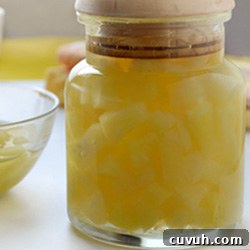
Almost everyone enjoys canned pineapple, though some home cooks stopped preserving it after finding that cooking the fruit in syrup could make the fibers tough and the texture less appealing. Fruit and vegetable fibers tend to toughen when cooked with sugar for long periods, so if you want the canned pineapple to retain a fresh, tender texture, avoid prolonged cooking in syrup on the stove.
Putting pineapple into jars with syrup and processing them in the jars produces a noticeably better product than cooking the fruit and syrup together in a kettle on the direct fire. However, because pineapple slices and chunks are firmer than berries, they require a brief preliminary treatment before jar-packing. This step, used widely in canning, is called blanching.
After trimming the pineapple—paring and removing the “eyes”—you can leave it in slices or cut it into chunks. When cutting, hold the pineapple at the crown and use a sharp knife. Place the prepared fruit into a wire basket or wrap it in cheesecloth for the blanching stage. Blanching means immersing the fruit in boiling water for a specific period to reduce bulk and soften the fibers.
Pineapple is typically blanched for five minutes. Soft fruits such as peaches and apricots are usually only scalded briefly to loosen skins, while firmer fruits like pineapple, apples and quinces are blanched for a longer interval. Scalding denotes a very short immersion in boiling water; blanching is essentially an extended scald.
When blanching pineapple, use only enough water to cover the fruit. The blanching water absorbs much of the pineapple’s flavor and can be reused to make the syrup, so there is no need to discard it. Note that this recommendation applies specifically to pineapple; blanching water from many vegetables can contain undesirable acids and should not be reused.
After five minutes in a covered kettle of boiling water, immediately hold the pineapple under cold water until it is cool enough to handle. Do not let it soak in cold water, as prolonged soaking can diminish the delicate flavor. Once cooled, pack the fruit into hot, sterilized jars.
Place rubber rings on the jars and set the covers in place without tightening them fully, then load the jars into the canner. Processing times vary by method: sterilize pineapple for thirty minutes in a hot-water bath, thirty minutes in a condensed-steam setup, twenty-five minutes in a water-seal unit, twenty-five minutes under five pounds of steam pressure, or eighteen minutes in a pressure cooker at ten pounds. After processing, remove the jars, tighten the covers completely and inspect the seals and joints for any leakage.
A thin or medium-thin syrup complements pineapple best. Measure the blanching water and for every two cups of it add three cups of sugar. For a thin syrup, heat only until the sugar dissolves; for a medium-thin syrup, boil about four minutes or until the mixture begins to thicken slightly.
STEPS IN CANNING PINEAPPLE
Canned pineapples are packed in syrup and processed in the jars to preserve flavor and texture.
Canning and Preserving
American
canned pineapples
- pineapple
- sugar
- water
-
Cut the pineapple into slices of the desired thickness.
-
Pare the slices; it is easier to pare slices than the whole fruit.
-
Remove the eyes; pineapple scissors can help with this task.
-
Blanch the pineapple for five minutes in a small amount of boiling water, using a wire basket or cheesecloth.
-
Rinse briefly in cold water until cool enough to handle—do not soak.
-
Prepare a thin or medium-thin syrup using the blanching water and sugar.
-
Pack the pineapple into hot, sterilized jars with good rubber seals.
-
Pour the syrup over the pineapple, leaving appropriate headspace.
-
Place the jar tops on without tightening completely, then process according to the method chosen.
-
Recommended processing times: 30 minutes in a hot-water bath; 30 minutes in condensed steam; 25 minutes in a water-seal unit; 25 minutes under 5 pounds steam pressure; or 18 minutes in a pressure cooker at 10 pounds. After processing, remove jars, tighten covers, and check seals and joints.