Italian baking—and Italian bread in general—tends to be more relaxed and rustic than French baking. Where a Parisian baguette must meet exacting standards of slashes, color and uniformity, an Italian loaf like ciabatta is judged more by character than by perfection. The stirato, Italy’s take on the baguette, embodies that artisan, individual quality.
The stirato lacks the polished sleekness of its French cousin but makes up for it with a charming, hand-made appearance. Imperfections are acceptable here; a slightly uneven shape or a stubby end is part of its appeal. That forgiving attitude makes this bread ideal for home bakers who value flavor and personality over rigid formality.
What gives a stirato its distinctive taste and texture is a pre-ferment called biga. A biga is a stiff, relatively dry starter dough prepared with a small amount of yeast and left to ferment slowly—often in the refrigerator—for many hours. This pre-ferment develops depth of flavor and aroma in ways that a quick dough cannot. In some respects its effect resembles a sourdough starter: both generate a pronounced backbone and complexity that elevate the final loaf beyond something mixed and baked within a few hours.
The biga is typical of Italian technique; the French equivalent is a poolish. The main difference is hydration: a poolish contains more water and is looser, while a biga is drier and holds its structure better when fully ripe. Both are used to extend fermentation and deepen flavor, but they behave slightly differently during mixing and shaping.
To manage long fermentation periods around a busy schedule, make the biga first thing in the morning—around 7am, for example—and plan to bake after work, around 6pm. This timing lets the biga develop slowly and fit neatly into a typical day.
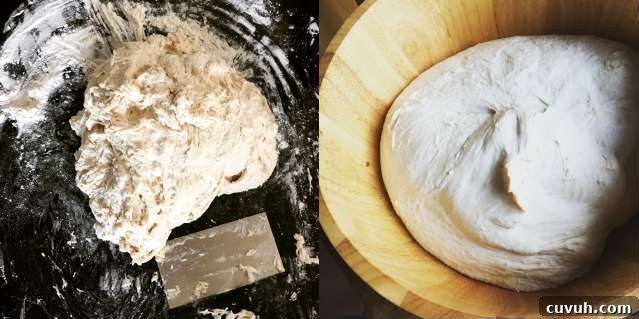
When you’re ready to mix the final dough, transfer the ripe biga to a clean mixing bowl and add about 280g of lukewarm water. Break up the biga with a spoon or spatula and let it sit for a few minutes to soften. Add 400g plain flour, 5g instant yeast and 10g salt, then blend into a rough dough. Allow the mixture to rest for five to ten minutes, then knead—by hand or in a mixer—until the dough becomes very elastic and the gluten is well developed, up to fifteen minutes.
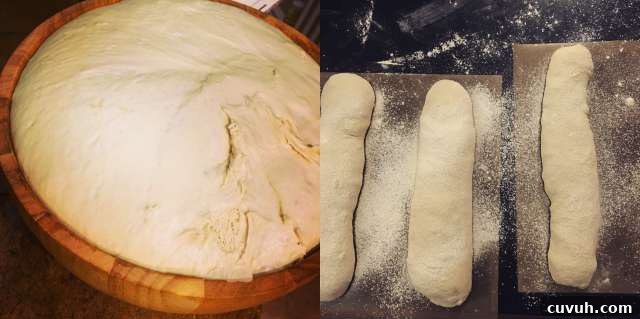
Cover the bowl with cling film and let the dough undergo bulk fermentation for an hour and a half to two hours, or until doubled in size. This stage follows the initial fermentation in the refrigerator and further builds flavor and structure.
After bulk fermentation, divide the dough into two equal pieces. If you have a dough scraper, use it; a knife works fine too. Cover the pieces and let them rest for ten minutes before shaping.
Shaping a baguette-style stirato is straightforward. Pat one piece of dough into a rectangle roughly 8cm by 13cm. With the long side facing you, fold the far edge over and press it in about a third of the way, then fold the opposite side in the same way so you end up with overlapped layers. Fold the dough in half top to bottom and press the seam to seal. Gently stretch the piece into a baton by rocking it back and forth until it reaches roughly 35cm. Keep the ends rounded and slightly stubby—the distinctive rustic look of a stirato.
Carefully transfer each loaf onto a single piece of well-floured baking paper or a reusable silicone mat; the latter reduces sticking and is eco-friendly. Let the shaped loaves proof for 45 minutes to an hour. This final proof allows the dough to relax and develop surface tension for a better rise in the oven.
Preheat the oven to 230°C and place a baking stone or heavy baking tray on a rack if you have one. Slide the loaves—on their paper—onto the stone or tray, then introduce steam by spraying water into the oven with a mister or by adding a hot pan of water to the oven base. Steam during the first part of baking encourages an even, glossy crust.
Bake the stirato for 20–30 minutes, until the crust turns a warm golden-honey color. Allow the loaves to cool completely before slicing or tearing them. The crust should be attractively crisp while the crumb remains soft and tender, a pleasant contrast to the finer, crisper crumb of a French baguette. Despite using the same basic ingredients as a French loaf, the extended fermentation and Italian shaping give the stirato a distinct character.
This recipe is adapted from Daniel Leader’s respected book Local Breads: Sourdough and Whole Grain Recipes from Europe’s Best Artisan Bakers, which many bakers find indispensable for learning traditional methods and adapting them for the home kitchen.