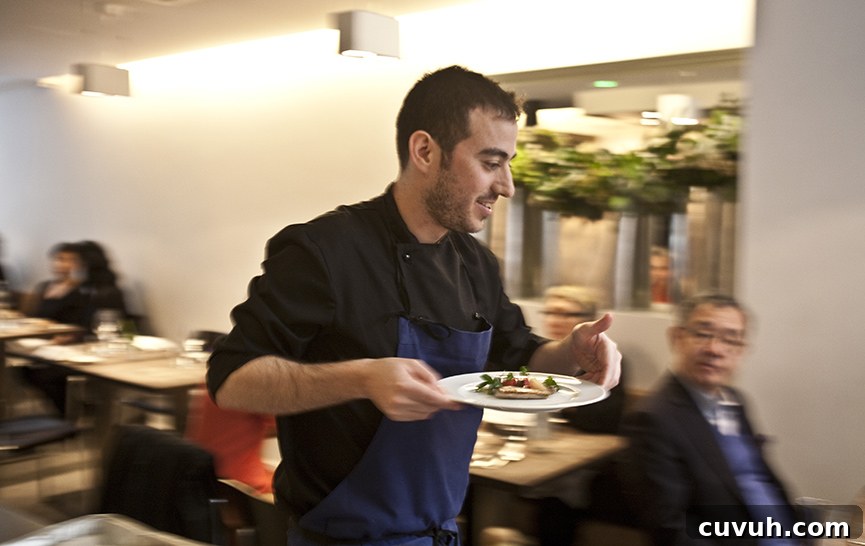
Redefining Haute Cuisine in Paris
Chicago-born chef Daniel Rose has left a lasting mark on Paris’s dining scene with his acclaimed restaurant Spring. Part of the bistronomy movement—where chefs favor intimate bistros, high-quality ingredients and fair prices over the formalities of traditional Michelin establishments—Spring offers a focused prix fixe menu of modern, thoughtful interpretations of classic French dishes. The restaurant’s 29 seats and consistently glowing reviews mean reservations fill up months in advance. We speak with Rose about French restaurant culture, the role of the open kitchen, and his favorite places to eat in Paris.
AndrewZimmern.com: Why did you move to Paris initially? Why did you stay?
Daniel Rose: I moved to Paris to finish college. I had never been to Europe and spoke no French, but I wanted to learn by immersion. Beyond the clichés of the Eiffel Tower and baguettes, I discovered a different approach to life rooted in work, food, family and tradition. That curiosity led me to stay and enroll in cooking school. For me, cuisine and restaurants became a gateway to understanding France and the French, and I’m still learning every day.
AZ.com: What are some of the differences between France and the U.S. when it comes to restaurant culture?
DR: In France there is an unspoken code governing how restaurants operate. You don’t typically order coffee with your main course; cheese is served before dessert; asking to take leftovers home is uncommon; and you don’t send a wine back unless it is truly flawed. It’s not that these things are impossible, but rather that they fall outside accepted behavior—one “doesn’t do them.” In some ways, a restaurant in France is less about service as a transaction and more about offering customers the privilege of participating in a longstanding tradition. Knowing how to participate properly signals education, experience and status. That mindset contrasts with the more customer-first, service-driven approach often seen in the U.S.
AZ.com: How would you describe your cooking style? Who has been your biggest influence?
DR: At Spring the cooking is rooted in classic French technique, even where preparations feel contemporary. I draw inspiration from the great figures of French cuisine—Careme, Escoffier, Fernand Point, Eugénie Brazier, Paul Bocuse and others—alongside living masters such as Pierre Gagnaire and Alain Passard. Their dedication to technique, flavor and respect for ingredients continues to shape my approach.
AZ.com: At the original Spring, you were the only employee. Now that you’ve moved to a larger space, you’re managing a larger staff. How has this changed your role in the kitchen?
DR: The change is significant: I’m now truly a chef in the managerial sense, not just a cook and host. I’m responsible for people’s careers, for mentoring, for resolving practical problems, and for guiding the business. It’s challenging but rewarding—especially because I now work with many talented colleagues. Successful collaboration is one of the most satisfying parts of running a restaurant.
AZ.com: Why did you decide to have an open kitchen?
DR: The open kitchen was less a decision than a necessity. In the first Spring, which changed its menu daily, the only way I could remain connected to both the kitchen and the dining room was to be visible to the guests. Seeing and feeling the energy in the room allowed me to gauge how people were enjoying the meal. It may sound a bit new age, but that connection was central to the restaurant’s early success.
AZ.com: What’s on your agenda when the restaurant is closed on Sunday and Monday?
DR: Those days are for recovery—rest, relaxed meals, and time with my wife Marie-Aude and our daughter Wilhelmina. We love to walk around Paris on the weekends; wandering the city is a great way to disconnect from the restaurant and recharge.
AZ.com: Favorite restaurants in Paris?
DR: We have many favorites. Yam’Tcha and Relais de l’Entrecôte are both high on the list, even though they offer very different experiences. For brunch we enjoy Le Bal Café, and Ten Belles is a favorite for coffee. For a late-night, traditional bistro meal I often go to Chez Denise.
AZ.com: What’s in your fridge?
DR: My wife, who is also a cook, keeps the fridge well stocked with ferments and stews. I often come home to slow-cooked dishes—recently potatoes braised with a pig shoulder from the Biarritz region, late-season tomatoes, and piles of homemade fermented cabbage. There are usually fresh fruit purées for Wilhelmina, and right now pears are especially good.
Get Daniel’s recipe for Deep-fried Oysters with Green Asparagus and Asparagus Vinaigrette.
Chef Daniel Rose blends classical French technique with a contemporary approach focused on fresh market ingredients. He is Chef and Owner of Spring, a restaurant that has influenced both the Paris and international dining scenes since his first 16-seat location opened in 2006. A Chicago native, Rose came to France to study and soon immersed himself in culinary training. Early positions at Auberge des Abers and Le Pré du Moulin provided foundational experience, and he worked with renowned chefs at top restaurants including Paul Bocuse, Jean-Pierre Bruneau and Yannick Alléno. A pivotal year as head chef in Panajachel, Guatemala, helped him transition from cook to chef, and in 2004 he returned to Paris to join the team at the Hôtel Meurice. Spring’s growing reputation led to a move to a larger space near the Louvre in Les Halles in 2010. Since then, Spring has received wide recognition and become a destination for international gastronomes. Rose and his restaurant have been featured in numerous publications and continue to draw attention for their thoughtful, ingredient-driven cooking.
Photograph by Owen Franken.